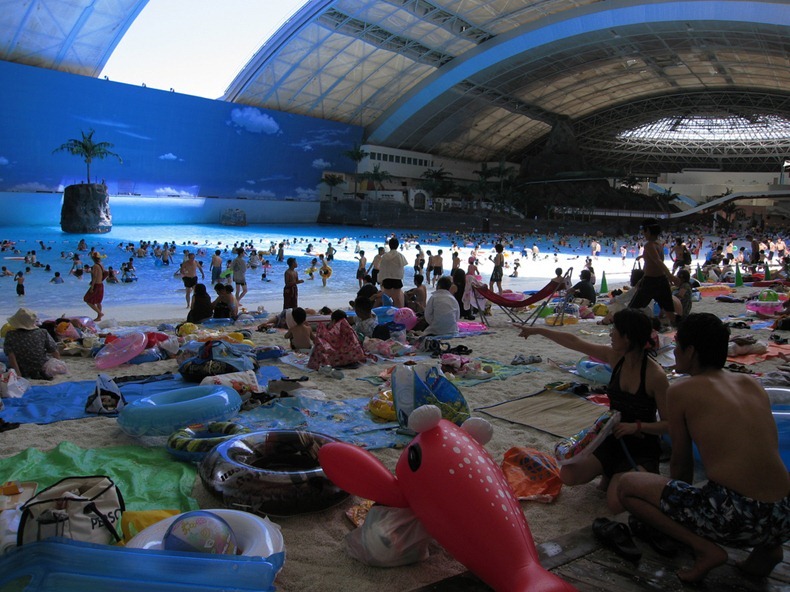
Seagaia Ocean Dome: An Artificial Beach in Japan

on Monday, 16 January 2012


Artificial beaches are gaining popularity all over the world. We can see them in Monaco, Hong Kong, Paris, Berlin, Rotterdam, Toronto and others, but the biggest among them is Seagaia Ocean Dome in Miyazaki, Japan.
The Ocean Dome, which was a part of the Sheraton Seagaia Resort, measures 300 meters in length and 100 meters in width, sported a fake flame-spitting volcano, artificial sand, artificial palm trees and the world's largest retractable roof, which provided a permanently blue sky even on a rainy day. The air temperature was always held at around 30 degrees Celsius and the water at around 28. The volcano becomes active every 15 minutes and spews fire every hour, and incredible waves lashes the beach for surfers’ delight.
The beach can accommodate 10,000 tourists, and the kicker is that there's an actual beach only 300 meters away.
It opened in 1993, and visitor numbers peaked in 1995 at 1.25 million a year.
ocean-dome-1
ocean-dome-2
ocean-dome-3
ocean-dome-4
ocean-dome-5
ocean-dome-6
ocean-dome-7
[via Gadling]

via source

Belaz - 73600, The Biggest Dump Truck In The Cis Country


The coal mine on the Bachat river is the largest region of the Kuznetsk Basin in Siberia. Its annual production is over 8 million and 700 thousand tons. It extracts fuel for energetic and metallurgic branches of Russian and many other countries of the world. The biggest dump truck BelAZ-75600 used here has a bearing capacity of 320 tons and weighs 560 tons.


The coal mine is located in the Kemerovo region. It is 300 m deep.


The mine was launched in 1949. It was the first enterprise in the world that started open-pit mining of metallurgical coal in 1966.


Today the mine exploits 29 excavators, 63 trucks,9 locomotive engines and 3 rock-drills.


The truck is 14,5 m high, 9,25 m wide and 7,22 m high.


It engine volume is 77,5 l.


BelAZ-75600 was created in 2005. It is the first truck in the factory that used alternate current electromechanical transmission, electronic monitor and diagnostic system.


In case its main system fails to function or the engine stops working, the vehicle uses pneumatic and hydraulic accumulators with enough energy to accomplish a couple of maneuvers.


The machine can develop 64 km an hour.


The machine has 3 control pedals.


Every wheel weighs 8 tons and costs around million rubles.


The truck is supplied with an air-conditioner, air cleaning system, additional heater, electric heated mirrors, signaling device that warns the driver when the truck approaches a high-voltage power transmission line.


Total road length in the region is 110 km. 55 m is occupied by technological motor roads.


Rocks are first loaded onto the trucks and then transported to the rake blades.


Every machine is operated by 4 drivers and never stops working. Every 250 hours it is sent to the service.


Every 12 hours the truck overcomes 150 km, carries 5-7 tons of rocks and spends 2-2,5 tons of petrol.


As soon as the sun had set, a number of explosions was heard along the mine.


Chinese excavator WK-35 and American excavator Р&Н-4100 ХРС were launched in 2011.


Location: Kemerovo region


via source

Balancing on a Giant Rubber Band 1000 ft in the Air


Slacklining_on_Table_Mountain
Photo: Greg Beadle via Cape Town Blog
With the wind whistling in your ears, a breathtaking view before your eyes, and a yawning gulf beneath your feet, would it matter whether your steps over the abyss were so... well... elastic? Balancing and bouncing about on a thin but obligingly flat strip of nylon webbing may sound like a lot of fun, but when this stretchy, oversized rubber band is all that lies between exhilaration and a long freefall to the gorge floor thousands of feet down, you know this zany extreme sport isn’t for sissies. Tightrope walking’s looser, more flexible but no less gnarly younger cousin, slacklining redefines the word dynamic.
Slacklining_over_Table_Mountain_2
Photo: Greg Beadle via Cape Town Blog
These pictures show two young South African enthusiasts of slacklining – which combines balance, concentration and fitness – taking a leisurely afternoon amble through the rarefied air over Cape Town in 2009. In so doing, Warren Gans and Sean Wakelin staked a claim as the first people to slackline on the famous Table Mountain landmark. Following the adrenalin-fuelled day, a serene evening set in, with photographer Greg Beadle remarking: “Sean had to strap his toes to stop the bleeding and carried his full pack back down, bravely carrying the war wounds of his first attempts at slacklining.”
Slacklining_on_Table_Mountain
Photo: Greg Beadle
OK, now bleeding feet we can take, but a first attempt at slacklining? Naturally, not everybody jumps in at the deep end in quite such drastic fashion; instead they start on less daunting low-slung lines. Like many extreme sports, slacklining presents itself as an activity for one and all, but a glance at some of the highlines set up in precipitous places tells you this take on the sport isn’t for old fogies with heart conditions. Just look at these drops. Yet, as intimidating as they look, the learning curve for the basics of slacklining is pretty quick. With a bit of perseverance over a few hours, most people are up and walking around like toddlers in playschool.
Harlan_Walking_the_Spire
Photo: Scott Rogers / Slackline.com
Slacklining was born when two wacky rock climbers living in Yosemite Valley in the early 80s, Adam Grosowsky and Jeff Ellington, began walking on parking lot chains and even ropes strung up between the trees to relieve boredom. They soon started stringing up their climbing webbing, and from there the sport spread. In 1983, the duo set up a 55-foot cable line at Lost Arrow Spire, nearly 3,000 feet up, but while neither of them was able to cross it, a webbing highline was set up in the same spot the next year by Scott Balcom and Darrin Carter. Balcom was the first person to cross the now now-famous line in 1985. Highlining had arrived.
Highlining has a helpfully self-explanatory name. The lines are placed great distances up in the air over ground or water. But most slackers, as they’re known, aren’t slackers when it comes to rigging, and take care to ensure that the anchors between which the line is secured are equally sized and suitably solid. No kidding. For safety’s sake, most highliners will also wear a climbing harness or swami belt with a leash attached to the slackline itself, but unleashed highline walks are not unheard of – especially in circles where some would argue balls outweigh brains by a considerable stretch.
Slacklining_over_a_Waterfall
Photo: via Velvet Antlers Blog
Lines threaded through with extra webbing, doubled up, or supplemented with climbing ropes running along them are safety measures taken by the saner among slackers, and even those with testosterone levels higher than their IQ scores will pad all areas of the rigging which might come in contact with abrasive surfaces that read ‘Snap’ in big scary letters to the trained eye. Today, Lost Arrow Spire is probably the world's most well-known and revered highline, yet only a few dozen people have actually walked the line, most of them in the last decade.

via source
 
© InfoSitBack All Rights Reserved